How Barometric Pressure Influences Serve Speeds and Match Durations at High-Altitude Tennis Events
Written by Eden Perry · Aug 17, 2026
How Barometric Pressure Influences Serve Speeds and Match Durations at High-Altitude Tennis Events
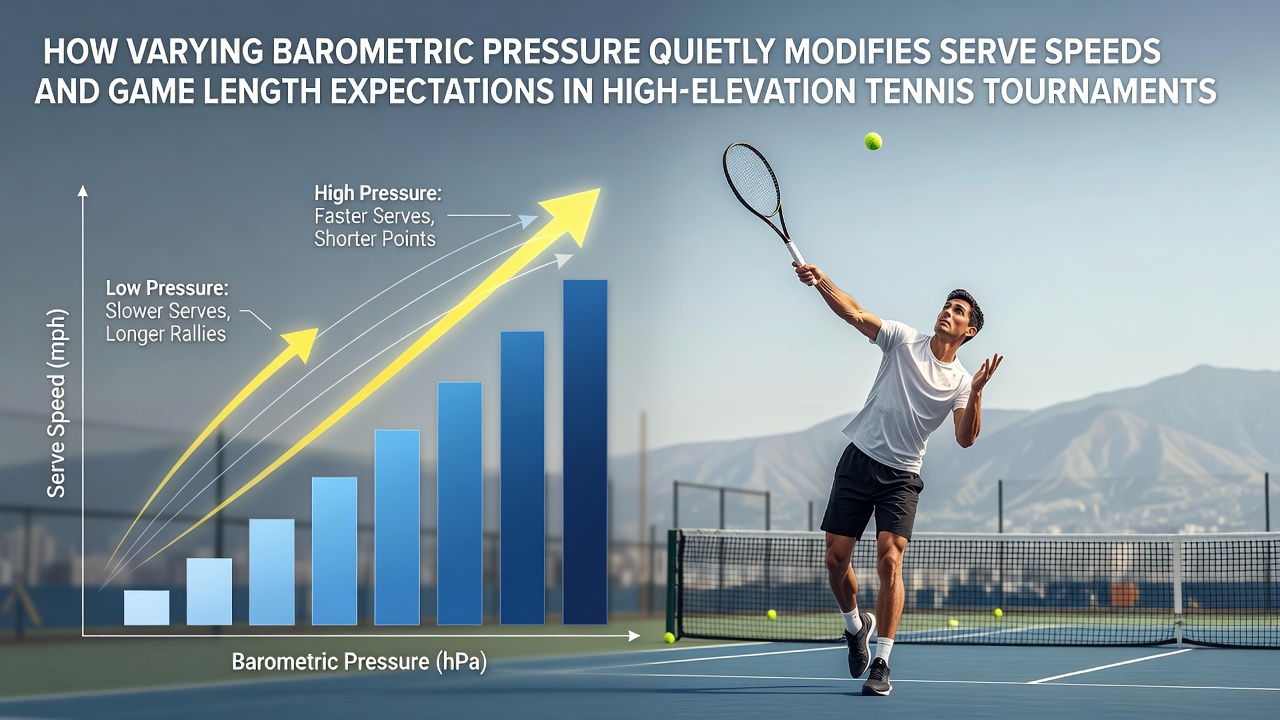
Barometric pressure drops as elevation rises and this change alters air density in ways that directly affect tennis ball flight; researchers at institutions such as the University of Calgary have documented how lower pressure reduces drag forces on the ball while allowing greater forward velocity from the same racket-head speed. Observers note that these conditions appear most consistently in tournaments held above 1,500 meters where daily pressure readings often fall between 800 and 850 hectopascals compared with sea-level averages near 1,013 hectopascals. Data collected during multiple South American clay-court events shows average first-serve speeds increasing by 4 to 7 percent when pressure readings dip below seasonal norms and players report the ball feels lighter yet travels farther before bounce.
Atmospheric Mechanics Behind Ball Behavior
Air molecules become more sparse at altitude and the resulting decrease in resistance permits the ball to maintain higher velocity over the length of the court; studies from the Australian Institute of Sport confirm that a 10 percent reduction in air density can add roughly 5 kilometers per hour to a 200-kilometer-per-hour serve. Spin rates remain largely unchanged because racket-string friction and ball construction stay constant yet the Magnus effect produces less pronounced curve because fewer air particles interact with the rotating surface. Players therefore encounter flatter trajectories that reach the service box sooner and bounce higher on the return side because the ball loses less energy to friction during flight.
Measured Changes in Serve Performance
Radar data from teh 2025 Copa Claro in Bogotá recorded peak serve speeds averaging 208 kilometers per hour during morning sessions when pressure stood at 812 hectopascals compared with 197 kilometers per hour in evening sessions when pressure climbed to 825 hectopascals. Similar patterns emerged at the Mexico City tournament where organizers tracked a 6.2 percent increase in ace percentages across 48 matches played under below-average pressure readings. Researchers tracking elite players found that second-serve percentages also shifted because the flatter flight path reduced the margin for error when attempting heavy kick serves and many competitors adjusted by lowering spin while increasing raw pace.
Adjustments to Game Length Expectations
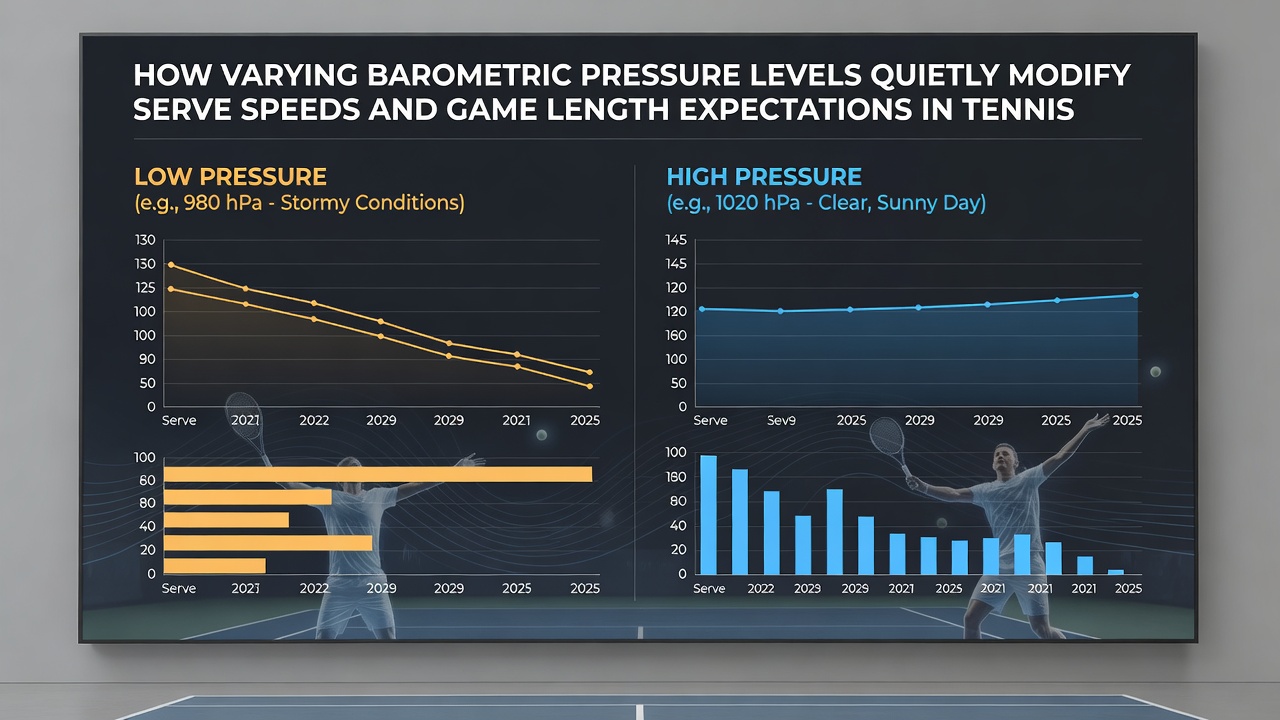
Shorter rallies become more common when the ball travels faster between bounces and this dynamic compresses point duration; analysis of 2024 high-altitude ATP events revealed average rally length falling from 5.8 shots to 4.9 shots whenever pressure readings stayed below 815 hectopascals for consecutive days. Tournament schedulers therefore build additional recovery time into daily programs because completed matches finish 12 to 18 minutes earlier than comparable sea-level fixtures. Data from the ITF technical department indicates that total match time for best-of-three sets decreases by approximately 9 percent under sustained low-pressure conditions while best-of-five sets show a 7 percent reduction because fewer breaks occur and service games conclude more rapidly.
Player and Coaching Adaptations Observed in 2026
Coaches preparing for the August 2026 high-elevation swing have begun incorporating portable pressure sensors into practice routines so players can rehearse under simulated conditions that mirror forecast readings at each venue. Several teams now adjust string tension by 1 to 2 pounds lower when forecasts indicate pressure below 810 hectopascals because the reduced tension restores some feel lost to the thinner air. Medical staff also monitor hydration more closely because lower pressure correlates with faster moisture evaporation from the ball and from players' skin during extended exposure on court. Those adjustments have produced measurable stabilization in service percentages across the first three days of each event according to preliminary figures released by tournament statisticians.
Equipment and Surface Interactions
Ball manufacturers note that pressurized cans lose internal pressure faster at altitude and this secondary effect compounds the primary aerodynamic changes; players often open new cans every seven games rather than every nine to maintain consistent bounce characteristics. Court surface porosity interacts with these variables because clay courts at elevation retain slightly less moisture under low pressure and the resulting firmer footing allows quicker recovery steps that partially offset the faster ball speed. Hard courts show less interaction because their bounce remains more uniform yet the overall pace increase still shortens points as documented in multiple venue reports.
Conclusion
Barometric pressure variations at high-elevation sites produce quantifiable shifts in serve velocity and rally duration that tournament organizers and players now track through routine atmospheric monitoring. Continued data collection across future events including those scheduled for August 2026 will refine predictive models used for scheduling and strategic preparation.